A Tax Residency Certificate (TRC) proves to a foreign tax authority that you are a Sri Lankan tax resident, so you can claim benefits under a Double Taxation Avoidance Agreement (DTAA). Any resident taxpayer (individual, company or partnership) can apply. First make sure your RAMIS profile is up to date: address, nature of business, TIN and profile details, and all returns, statements and payments filed. Then complete the IRD's prescribed TRC application form and email it with supporting documents to the International Tax Affairs Unit at itp@ird.gov.lk. Individuals must also send their NIC and their passport bio page, all visa pages and every page with arrival or departure stamps, split across two emails if the files exceed 10 MB. There is no due date to apply, and a TRC is valid for 12 months from the date of issue.
If you earn money from another country, that country may want to tax it, and Sri Lanka will usually tax it too. A Double Taxation Avoidance Agreement (DTAA) is what stops you paying full tax twice. To use one, though, the foreign tax authority needs proof that you're a Sri Lankan tax resident. That proof is a Tax Residency Certificate (TRC).
In January 2026 the Inland Revenue Department published a notice to taxpayers that sets out, step by step, how individuals, companies and partnerships obtain a TRC. This guide walks through it in plain language: who can apply, what to send, where to send it, and the checks to do first so your application isn't held up.
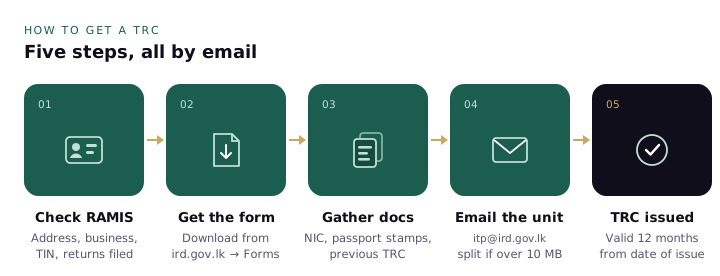
Five steps, all done by email. The step people skip is the first one.
Why you'd need a TRC
Say you're a Sri Lankan resident and a client, employer, bank or company abroad pays you. The paying country may deduct tax at its full domestic rate. If Sri Lanka has a DTAA with that country, the treaty may let you pay less there, or not at all. Either way you avoid being taxed in full in both places.
The foreign tax authority (or the payer acting for it) won't take your word that you're resident here. The IRD notice is explicit: "to enjoy the tax benefits, you need to submit a TRC to the foreign tax authority as proof that you are a tax resident of Sri Lanka."
Common situations where a TRC comes up:
- A foreign client or platform wants to withhold tax on your fees and asks for residency proof to apply the treaty rate.
- You receive dividends, interest or royalties from abroad and the paying institution asks for a TRC.
- A Sri Lankan company exports services and a customer's tax authority needs proof before it releases payment without full withholding.
- A foreign authority asks for proof of your tax residence for some other tax-related requirement.
The IRD keeps the list of countries Sri Lanka has DTAAs with on its website, under Publications → International Relations. Check that list first: if there's no treaty with the country paying you, a TRC may not reduce the foreign tax at all.
For how foreign income is taxed on the Sri Lankan side, including the foreign tax credit, see our foreign income tax guide.
Who can apply
According to the notice, any resident taxpayer who needs a TRC, whether to claim DTAA benefits or to meet tax-related requirements in another country, can apply. That covers all three taxpayer types:
- Individuals, including freelancers, remote workers, consultants and investors.
- Companies.
- Partnerships.
The certificate confirms residence, so it's for people and entities who are actually tax resident in Sri Lanka. If you're unsure whether you qualify, for example because you spent a large part of the year abroad, settle that question before you apply. The passport stamps the IRD asks individuals for (below) are how it checks.
Before you apply: get your RAMIS profile right
This is the step most likely to slow you down. The IRD advises taxpayers to make sure their records in RAMIS (the Revenue Administration Management Information System, the system behind IRD e-Services) are current and accurate before submitting. In particular:
- Your current residential or registered address is updated.
- The nature of your business activity is correctly recorded, where applicable.
- Your TIN and taxpayer profile information are accurate.
- All applicable tax returns, statements and payments have been made.
Point 4 deserves attention. A certificate saying you're a Sri Lankan taxpayer in good standing sits awkwardly with a missing return or an unpaid balance. If you have outstanding filings, deal with them first. The return for Y/A 2025/2026 is due 30 November 2026; our guide to filing your income tax return covers the process. If you don't yet have a TIN, start with registering for a TIN.
The application form
You apply using the prescribed form issued by the IRD, which you download from the Downloads → Forms section of ird.gov.lk. There's no portal workflow for this; you fill in the form and send it with your documents by email.
The notice puts the responsibility on you: everything in the application must be "complete, accurate and supported by relevant documentation where required." An incomplete form or a missing scan simply means a follow-up email from the IRD and a longer wait.
What to send
Every applicant
| Document | When it's needed |
|---|---|
| Completed TRC application form | Always |
| Scanned copy of any previously issued TRC | If you've had one before |
| The request from the foreign tax authority or payer | If one was made to you |
| Certificate of Incorporation or Business Registration | As listed in the notice; see the note below |
| Authorisation letter | If someone else will collect the original TRC on your behalf |
The notice lists the Certificate of Incorporation or Business Registration among the general requirements. For companies and partnerships that's straightforward. If you're an individual with no registered business, ask the unit what it needs instead when you email, rather than leaving a gap unexplained.
The authorisation letter matters because the TRC is a physical original. If you won't collect it yourself, the person who does will need your written authority.
Individuals: additional documents
- A scanned copy of your National Identity Card (NIC).
- Scanned copies of your passport bio-data page, all visa pages, and every page showing arrival or departure stamps.
The passport pages are how the IRD checks your physical presence in Sri Lanka, so don't send a selection. Scan every page that carries a stamp, even old or faint ones.
File-size tip from the notice: if your scans exceed 10 MB, split them across two separate emails. A full passport scanned at high resolution often goes over that limit.
Where to send it
Email the completed application and supporting documents to the IRD's International Tax Affairs Unit:
The IRD may come back to you for additional information or documents if it needs them to decide your residence status. Reply promptly and completely: each round trip adds time.
A practical tip: put your name, TIN and the country you need the TRC for in the email subject line, and list the attachments in the body. If you split the scans across two emails, say so ("1 of 2", "2 of 2") so the two halves are matched up.
Deadlines and validity
There's no due date. You can apply whenever you need a certificate. There's no annual window to miss.
A TRC is valid for 12 months from the date it's issued. That has two consequences:
- If you have recurring foreign income, such as an ongoing client contract or regular dividends, expect to apply again each year. Keep a scan of each certificate; the next application asks for your previous TRC.
- Apply before you need it, not on the day the foreign payer asks. Build in time for the IRD to process the application and possibly ask follow-up questions.
A quick checklist
- Confirm Sri Lanka has a DTAA with the country concerned (IRD website → International Relations).
- Update your address, business activity and profile in RAMIS; check your TIN.
- File any outstanding returns and statements and settle any payments due.
- Download and complete the prescribed TRC application form.
- Scan your previous TRC, any foreign request, and your incorporation or business registration certificate.
- Individuals: scan your NIC, passport bio page, all visa pages and all stamped pages.
- Add an authorisation letter if someone else will collect the original.
- Email everything to itp@ird.gov.lk, splitting it across two emails if over 10 MB.
- Diary the expiry date: 12 months from issue.
The bottom line
Getting a TRC is mostly paperwork, but the paperwork has to line up. A clean RAMIS profile and up-to-date returns are what make the application straightforward. A missing return or an old address is what gets it held up.
That's where TaxWise helps. The foreign income that leads to a TRC request still has to be declared on your Sri Lankan return, converted to rupees and matched against any tax paid abroad. TaxWise works out your Y/A 2025/2026 return from what you enter, including foreign income, and gives you each figure ready to file, so the "all returns filed" box on this checklist is already ticked when a foreign payer asks.
Start your return at taxwise.lk →
TaxWise is an independent tax preparation tool, not affiliated with the Inland Revenue Department. This article summarises the IRD's Notice to Taxpayers "How to obtain Tax Residency Certificates (TRC)" (January 2026) for general information. Requirements can change, so check the current notice and form on ird.gov.lk before applying, and consult a qualified tax advisor about your specific situation.