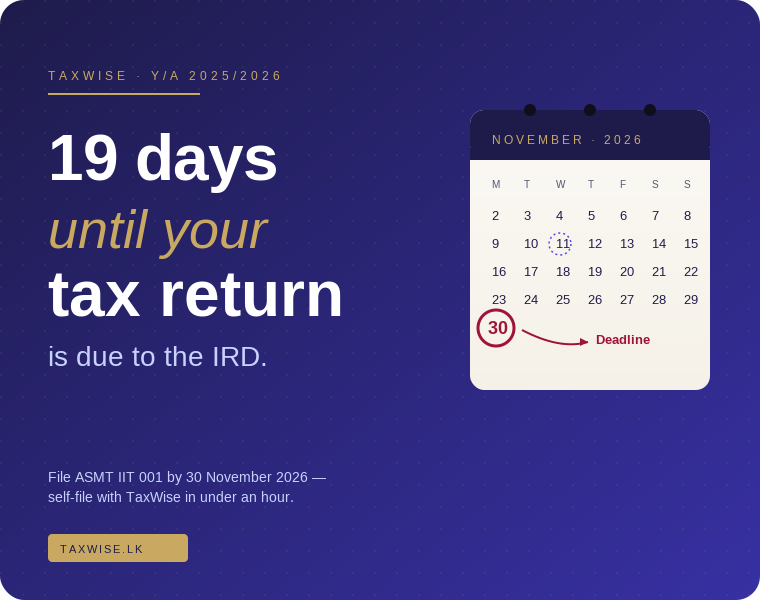
The individual income tax return for Year of Assessment 2025/2026 (1 April 2025 – 31 March 2026) is due on or before 30 November 2026. Before filing, settle eight things: verify your TIN and IRD e-Services access; gather every income document (T-10/APIT, interest, dividends, rent, freelance, foreign); collect business expense evidence (cash payments of LKR 500,000 or more are non-deductible); reconcile every rupee of creditable WHT already deducted (excluding 15% dividend WHT, which is a final tax, not a credit); confirm reliefs including the LKR 1,800,000 personal relief; prepare your Assets & Liabilities statement (Form 4, Modules A–E) as at 31 March 2026; validate your TIN/NIC formats and refund bank details; and dry-run the full calculation so you know whether you owe a balance or are due a refund. TaxWise walks you through the entire return in six steps — sign up, add income, log expenses and reliefs, complete Form 4, review your line-by-line liability, and export IRD-compliant PDFs — typically in under an hour.
If you earn income in Sri Lanka, 30 November 2026 is the single most important date on your calendar right now. It is the statutory deadline for filing your individual income tax return — Form ASMT IIT 001 — for the Year of Assessment 2025/2026 (1 April 2025 to 31 March 2026). Miss it and the Inland Revenue Department (IRD) applies late-filing penalties, interest on unpaid tax, and additional assessments that can quickly exceed the original liability. The good news: you still have time, and filing has never been simpler. This guide walks through exactly what to do before 30 November — and shows how TaxWise lets you self-file the entire return without hiring a consultant.
Who must file by 30 November?
You are required to file an IIT return for Y/A 2025/2026 if any of the following apply:
- You earned employment income above the tax-free threshold of LKR 1,800,000 for the year
- You received business, professional, or freelance income
- You earned investment income — interest, dividends, rent, royalties, or capital gains
- You received foreign income remitted to Sri Lanka
- You are a registered taxpayer with a TIN, even below the threshold (NIL returns are still required when the IRD has asked you to file)
Self-employed taxpayers who have already paid quarterly installments reconcile estimated to actual income in the annual return.
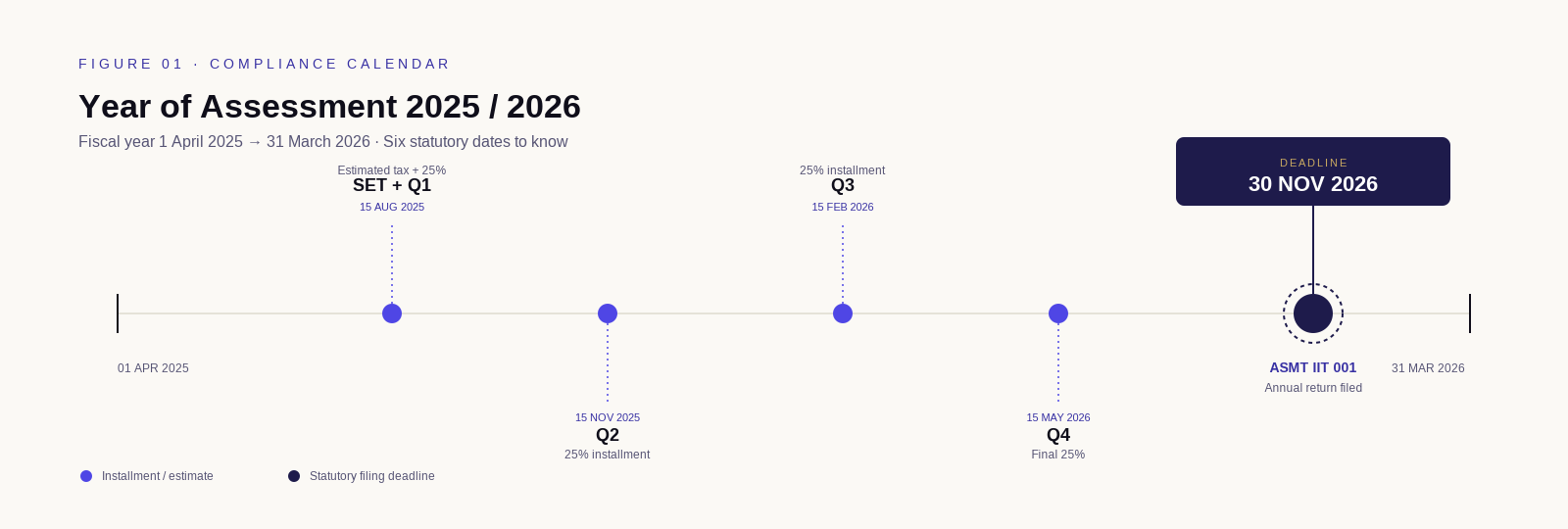
Your pre-filing checklist: eight things to settle before you submit
1. Verify your TIN and IRD portal access
Confirm your Taxpayer Identification Number (TIN) is active and your IRD e-Services login works. If your access is locked or you have lost credentials, reset them early — IRD support slows as the deadline approaches.
2. Gather all income documents
Collect every document that proves income during 1 April 2025 – 31 March 2026:
| Document | Covers |
|---|---|
| T-10 (APIT certificate) | Tax your employer withheld each month |
| Bank interest statements | Interest income and 10% WHT deducted |
| Dividend vouchers | Listed and unlisted companies, 15% WHT (final) |
| Rental income records | Lease agreements and receipts |
| Freelance invoices | Business receipts and client payments |
| Foreign income statements | Converted to LKR at the rate on the date of receipt |
| Capital gains documents | Property deeds and share transaction confirmations |
3. Collect expense evidence (business income only)
Only expenses incurred in the production of assessable income are deductible. Gather business invoices, apportioned utility bills, professional subscriptions, and depreciation schedules. Any cash payment of LKR 500,000 or more is non-deductible — pay by bank transfer or cheque.
4. Reconcile WHT credits
Add up the Withholding Tax already deducted at source that is creditable against this year's liability — your employment APIT, 10% WHT on bank interest, and WHT on rent and service fees. These reduce your gross tax directly; missing a certificate means paying tax twice.
One important exclusion: the 15% WHT on dividends from resident companies is a final tax — the dividend income is not reassessed on your return, and the 15% is not a credit against tax on your other income. Keep dividend vouchers for your records (and to disclose the final-taxed amount), but do not add that 15% to your credit total.
5. Confirm reliefs and deductions
For Y/A 2025/2026 you are entitled to:
- Personal relief of LKR 1,800,000 — flat allowance, no age-based top-up
- Approved pension fund contributions
- Life insurance premiums within prescribed limits
- Qualifying donations to approved charities
- Solar panel and rupee-denominated investment reliefs where applicable
Pull supporting documents now — the IRD can request them up to five years later.
6. Prepare your Assets & Liabilities statement (Schedule 6 / Form 4)
The step that stops most filers. You must declare, as at 31 March 2026:
| Module | Content |
|---|---|
| A | Immovable properties (land, buildings) |
| B | Vehicles, bank balances, shares, jewellery, cash |
| C | Business equity |
| D | Loans and liabilities |
| E | Asset acquisitions and disposals during the year |
If last year's Form 4 is handy, half the work is already done — you only update movements.
7. Validate your identifiers
The IRD return rejects on format errors:
- TIN: 9 digits, first digit 1–9
- NIC: 9 digits + V/X or 12-digit new format
- Bank details confirmed if you expect a refund
8. Do a dry-run tax calculation
Before filing, calculate what you owe and compare against installments already paid (SET quarterlies, APIT, WHT). This tells you whether you are writing a cheque or claiming a refund — and surfaces errors while there is still time to fix them.

Why most filers stall
The IRD portal is free, but it is not easy. You are expected to:
- Know which schedule (S1–S4) each income stream belongs to
- Apply the correct progressive brackets for Y/A 2025/2026
- Distinguish assessable, non-assessable, and exempt income
- Calculate reliefs, WHT credits, and final tax payable by hand or in a spreadsheet
- Transcribe everything into IRD's forms without a single typo
One missed WHT credit or a transposed digit on a dividend amount can cost you tens of thousands of rupees or trigger a reassessment months later.
Self-file with TaxWise in under an hour
TaxWise is a Sri Lankan tax platform built for self-filers. It handles the maths, the IRD rules, and the form generation — you focus on your numbers, not on reading the Inland Revenue Act.

Step 1 — Sign up and open your tax year
Register with your email, add your TIN and NIC, and open the Y/A 2025/2026 workspace. TaxWise pre-loads the current brackets, personal relief, and WHT rates.
Step 2 — Enter your income
Add each income stream. TaxWise auto-assigns the correct IRD schedule (S1–S4) and captures WHT already deducted as a credit in the same entry.
Step 3 — Log expenses and reliefs
Enter expenses with the production-of-income flag. TaxWise automatically applies IRD rules — blocking non-deductibles, flagging cash-over-LKR 500,000 payments, and apportioning mixed-use assets.
Step 4 — Complete the Assets & Liabilities statement
Fill Modules A–E through a guided interface. Carry forward last year's declaration if you filed with TaxWise previously.
Step 5 — Review your calculated liability
TaxWise shows, line by line, your gross income by schedule, reliefs applied, taxable income after personal relief, tax at each bracket, WHT credits deducted, installments paid, and final tax payable (or refund due). Every figure is backed by the exact section of the Inland Revenue Act.
Step 6 — Generate and submit your IRD forms
Export your completed ASMT IIT 001 and supporting schedules as IRD-compliant PDFs. Upload them to the IRD e-Services portal, pay any balance due, and keep your TaxWise archive as your audit trail.
Expecting a refund? File early.
Under the IRD's section 150 fast-track, senior citizens and other eligible filers can receive refunds faster if they file well before the deadline. Even outside the fast-track, early returns are processed before the 30 November surge — refunds arrive weeks sooner.
Do not wait until 29 November
Every year the IRD portal buckles under traffic in the last 48 hours. Filers lose data, payment gateways time out, support queues close. Give yourself a weekend with TaxWise and walk into the deadline knowing the return is filed and the tax year is closed.